
Central Ohio seeding crews
Hydroseeding in Columbus, OH
New lawns, builder lots and washed-out slopes seeded for wet clay subsoil and summer downpours.
- Free site visits and written quotes
- Seed mix, mulch and prep listed line by line
- Watering schedule in writing with every seeding
Getting Grass to Take on Glacial Till
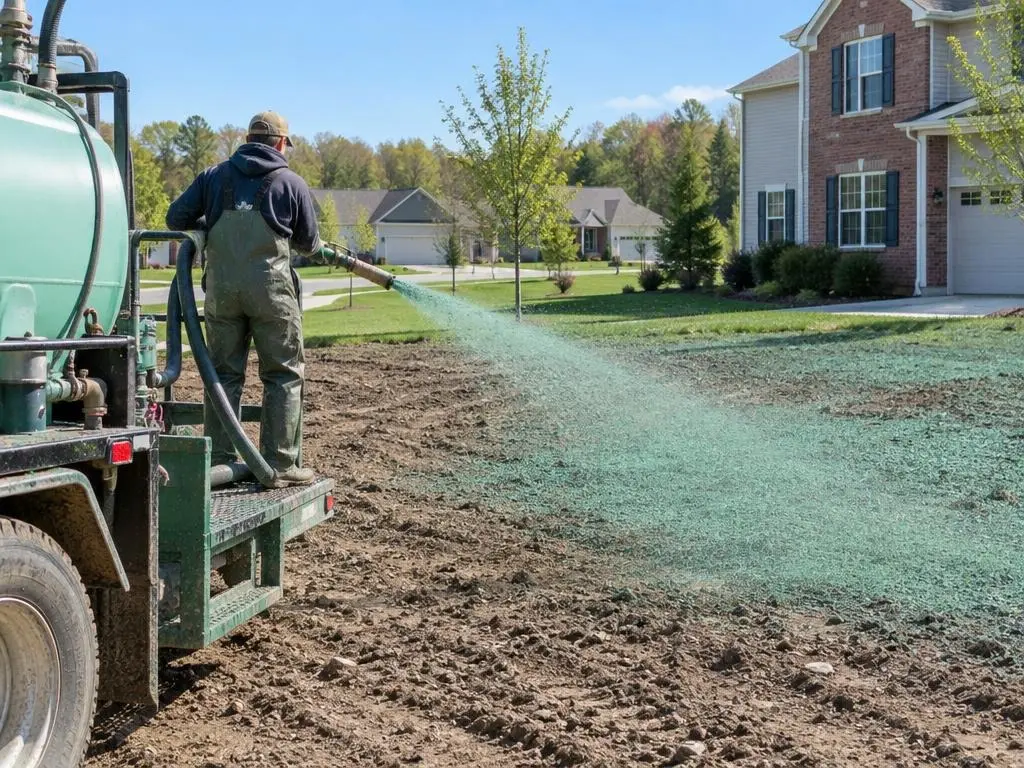
Hydroseeding in Columbus means spraying a slurry of seed, wood or paper mulch, fertilizer and tackifier onto prepared soil so it sticks, holds moisture and sprouts fast. We use it for new lawns after a build or a tear-out, for bare lots that need to be stabilized before a builder can close out a permit, and for slopes and ditches that keep washing. Hydro seeding sits between dry seed and sod: University of Nebraska Extension notes that it costs a little more than dry seeding but generally less than sodding, and that hydroseeded grass generally appears within 5 to 7 days, where dry seed usually takes two to three weeks.
Flat ground that holds water
Columbus is mostly flat because a large glacier covered most of Ohio during the Wisconsin Ice Age. What it left behind is till plain. The USDA describes Crosby, a soil of large extent on the till plains of Ohio and Indiana, as silt loam over dense till, with 35 to 45 percent clay in the subsoil and a perched water table 0.5 to 2 feet down in winter and spring in normal years. Nearby higher spots carry better-drained soils, and the low depressions carry poorly drained ones. In practice that means many Central Ohio yards stay soggy into April, then bake hard in August. New builds make it worse, since equipment compacts the subsoil and the topsoil is often stripped or buried.
Grass seed does not care how good the slurry is if its roots hit a compacted, waterlogged layer two inches down. That is why every lawn job we price starts with prep: loosening compacted ground, bringing in topsoil where it is missing, and shaping the surface so water moves away from the house instead of sitting in the middle of the yard.
Ravines, creeks and sudden storms
The flat ground is broken by creek valleys. Tributaries to Alum Creek and the Olentangy cut ravines through shale, and Scioto tributaries cut through limestone, so neighborhoods along those creeks have real slopes and fast runoff. Elevation in Franklin County runs from 1,132 feet near New Albany down to 670 feet where the Scioto leaves the county near Lockbourne. Columbus averages about 41.6 inches of precipitation a year, and July is the wettest month at about 4.7 inches, often in thunderstorms. A bare slope above a ravine can lose its seed and topsoil in one of those storms. On ground like that we use bonded hydromulch at heavier rates or pin down erosion control blankets before the grass gets established.
When to seed in Central Ohio
Columbus sits in USDA hardiness zone 6b, bordering 7a, with a humid continental climate: warm, muggy summers and cold winters. Lawns here are cool-season grasses such as tall fescue, Kentucky bluegrass and perennial ryegrass. Those grasses germinate and root best in cool nights and warm soil, which is why extension services across the region point to late summer and early fall. Iowa State calls mid-August to mid-September the best time to start a lawn from seed, and the University of Tennessee lists late August to mid-October. Columbus falls between the two, and our own window runs from late August into early October, with spring seeding from about mid-April into May as the second choice.
Spring seedings work, but they have to root before July's heat and the dry spells that follow. Seed sown in midsummer needs heavy watering to survive. Seed sown too late in fall may sprout and then get lifted by frost. We will seed outside the best windows when a permit, a closing date or a washing slope cannot wait, but we will tell you what it means for watering and results.
Hydroseed, sod or dry seed
- Sod looks complete the moment the rolls are laid, which makes it the right call for a small, shaded front yard or a spot that has to look done this week. It costs the most per square foot and still needs daily watering while it roots into the soil below.
- Dry seed spread by hand or with a spreader is the cheapest, but on a slope or in a storm it moves. Birds take some, and it is slower to come up.
- Hydroseed costs more than dry seed and much less than sod. The mulch holds the seed in place and keeps it damp, which matters on our silty soil that crusts after a hard rain. It is the usual choice for a new lawn of a few thousand square feet or more, for slopes, and for construction sites that need cover fast.
Building sites and stormwater rules
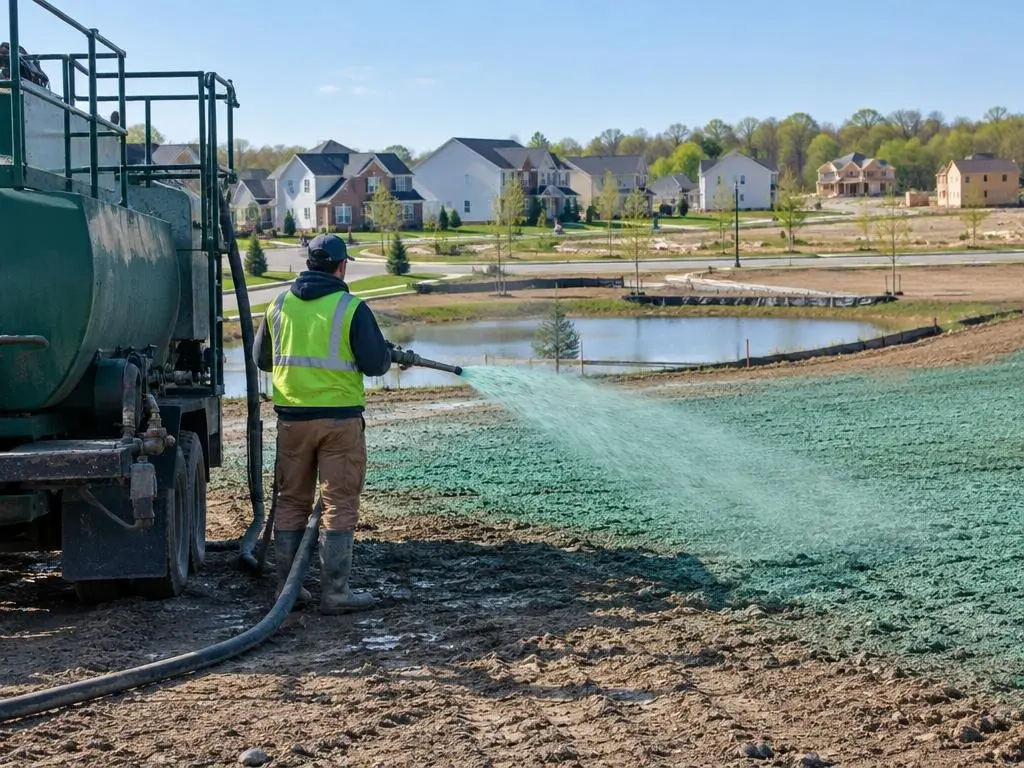
Central Ohio keeps building, from subdivisions around Powell and Pickerington to large industrial and data center sites near New Albany. Ohio EPA's Construction Stormwater General Permit covers construction that disturbs one acre or more anywhere in the state. Owners need a stormwater pollution prevention plan before they file for coverage, and in the Big Darby Creek watershed and parts of the Olentangy River watershed the filing has to be made at least 45 days before work starts, compared with 21 days elsewhere. In unincorporated Franklin County, the Franklin Soil and Water Conservation District reviews those plans and inspects sites. We are hydroseeding contractors who work to those plans: silt fence and inlet protection up front, temporary seed on idle ground, and permanent seeding and erosion control at the end.
What a job looks like
- A site visit to look at the soil, drainage, slope and access for our truck and hoses
- A written quote that separates prep, topsoil, seed and mulch, and any blankets or silt fence
- Grading and soil prep, then the seed mix chosen for sun, shade and use
- Hydroseed applied in even passes, heavier on slopes and edges
- Written watering instructions, then a check on germination
Expect roughly four to six weeks before a sprayed lawn here can take its first mowing. Call (380) 233-4081 with your questions, or ask for a visit.
Common Questions
What do Columbus homeowners typically pay to hydroseed a yard?
National cost guides put residential hydroseeding at roughly $0.06 to $0.35 per square foot, with each guide landing somewhere in that span. For a yard of 5,000 square feet, HomeGuide's range runs from $1,000 up to $1,750, and most companies have a minimum job fee of a few hundred dollars. Grading, topsoil and slopes add to that, so we give you a written quote after a site visit.
Is there a downside to hydroseeding?
It is not an instant lawn. Seed shows in about a week and a lawn needs four to six weeks before its first mowing, and the seed has to be watered several times a day in warm weather. It also costs more than spreading dry seed. On a small shady patch, sod or dry seed may make more sense.
What is the best month to hydroseed in Columbus?
For the cool-season grasses that grow here, late August through September is the strongest window, with early October still workable. Spring, from about mid-April into May, is second best. Midsummer seeding can work with careful watering, but it is harder on young grass.
Can I hydroseed my lawn myself?
Small hydroseeding kits exist for patches, but a lawn takes a tank mixer, a pump and a lot of slurry applied evenly. The bigger factor is prep: grading, loosening compacted soil and adding topsoil. Many homeowners do the watering and let a crew handle the prep and spraying.
Why does water sit on my yard after it rains?
Much of Central Ohio has silty topsoil over dense, clay-rich till, and in winter and spring some of those soils carry a perched water table only inches to a couple of feet down. Construction compaction makes it worse. Regrading so water moves off the lawn, plus loosening the subsoil, usually helps more than any seed choice.
Does one house lot in Franklin County call for silt fence?
Ohio EPA's construction stormwater permit applies at one acre of disturbance. Your city or township may have its own rules for smaller lots, and the Franklin Soil and Water Conservation District publishes erosion-control guidance for individual lot builders. Ask your building department what your permit requires; we can install it either way.
How long does hydroseed take to grow?
Under good conditions the first sprouts show in 5 to 7 days, and most lawns fill in over the next few weeks. Give it four to six weeks before the mower comes out, and keep foot traffic off until then.
What We Seed, Grade and Protect
Six services that cover bare ground from the first cut of the grader to a thick, mowed lawn.
Lawn Hydroseeding
New lawns sprayed on graded, loosened soil for homes, additions and tear-outs.
Learn more →Construction & Commercial Hydroseeding
Seeding and stabilizing subdivisions, commercial pads, basins and right-of-way for builders.
Learn more →Erosion Control Blankets & Hydromulch
Blankets, bonded hydromulch and seeded channels for slopes, ravine edges and ditches.
Learn more →Silt Fence Installation
Perimeter silt fence, inlet protection and repairs for home builders and site contractors.
Learn more →Dirt Work & Yard Grading
Fine grading, topsoil, drainage fixes and soil prep so seed has something to grow in.
Learn more →Lawn Renovation & Reseeding
Overseeding thin lawns and rebuilding patchy or damaged turf without starting over.
Learn more →Towns We Cover Around Columbus
We work across Columbus and Franklin County and into the counties around it. North of the city, Dublin, Worthington, Powell, Westerville and Delaware sit near the Scioto and Olentangy and the Hoover Reservoir, with ravine lots next to newer subdivisions. Upper Arlington and Bexley are older, tree-heavy suburbs where most of our work is lawn renovation and seeding after additions or rebuilt homes. To the west and southwest, Hilliard, Grove City, Plain City and Marysville run toward Big Darby Creek and open farmland, where new neighborhoods go up on flat, slow-draining ground. East and southeast, Gahanna, New Albany, Reynoldsburg, Pataskala, Pickerington, Canal Winchester and Groveport mix creek corridors with some of the biggest construction sites in the region. Farther out, we seed and stabilize in Lancaster, Circleville and Sunbury. Pick a town below for the soil, creeks and building activity that shape seeding in that part of Central Ohio.
- Hydroseeding in Columbus, OH
- Hydroseeding in Dublin, OH
- Hydroseeding in Westerville, OH
- Hydroseeding in Hilliard, OH
- Hydroseeding in Grove City, OH
- Hydroseeding in Upper Arlington, OH
- Hydroseeding in Gahanna, OH
- Hydroseeding in New Albany, OH
- Hydroseeding in Powell, OH
- Hydroseeding in Worthington, OH
- Hydroseeding in Delaware, OH
- Hydroseeding in Pickerington, OH
- Hydroseeding in Reynoldsburg, OH
- Hydroseeding in Canal Winchester, OH
- Hydroseeding in Marysville, OH
- Hydroseeding in Groveport, OH
- Hydroseeding in Lancaster, OH
- Hydroseeding in Pataskala, OH
- Hydroseeding in Plain City, OH
- Hydroseeding in Bexley, OH
- Hydroseeding in Circleville, OH
- Hydroseeding in Sunbury, OH
Why Homeowners Call Hydroseeding Columbus
Prep comes first
We price grading, decompaction and topsoil as real line items because new lawns around here fail more often from seed laid on packed Central Ohio clay than from anything else.
Honest timing
If waiting until late August will give you a better lawn than seeding in July, we tell you, and we explain what it takes if you cannot wait.
Builder-ready erosion control
We install silt fence, inlet protection, blankets and hydromulch to the site plan and keep track of what needs to stay until the ground is stabilized.
Written aftercare
Every job ends with a written watering and mowing schedule, because new seed needs water two or more times a day in warm weather.
Have Bare Dirt Waiting? Let Us Take a Look
Free site visits around Columbus and Central Ohio, with a written quote you can compare.